By Mrs Johns (English Teacher)
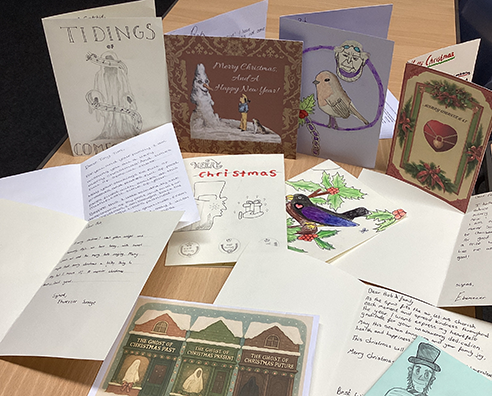
My Year 8 students have recently been studying A Christmas Carol by Charles Dickens, exploring its gothic atmosphere, moral transformation and social message. To conclude their work on the novel, they have spent the past few weeks designing their own Victorian-style Christmas cards. Inside each card, students wrote as if they were Ebenezer Scrooge, not as the miser he begins as, but as the changed man we meet at the end of the story, using key vocabulary and phrasing drawn directly from Dickens’ text. They also considered how to represent the novel’s symbols and motifs, working either by hand or digitally to capture an authentic nineteenth-century feel.
Did you know that the first commercial Christmas card, produced in 1843 by Sir Henry Cole, was invented simply to save time on letter writing? As the tradition developed, designs became increasingly unconventional. Some Victorian cards featured dancing insects, rats riding lobsters or even dead birds — imagery that feels eerie or unsettling to us today. Yet this fascination with the strange and the shadowy sits alongside the gothic qualities within A Christmas Carol itself. Ghosts, moral horror, transformation and the vivid contrast between darkness and light invite students to explore deeper themes of compassion, social justice and human change - ideas as relevant now as in Victorian London. Our students embraced this connection in their own designs, using visual hints of darkness, redemption and the supernatural to reflect both the novel and the world that produced it.
As our budding Victorian card-makers will tell you, this has been more than a creative task. It has offered a meaningful way of connecting literature, history and art, and of remembering that even the hardest hearts can warm with kindness.
So, from all of us here, a very Merry Christmas and in Tiny Tim’s words: “God bless us, every one!”












.png&command_2=resize&height_2=85 "Student-Led Citizenship")