
Our School
- Welcome from the Headmistress
- Vision & Ethos
- Why All Girls?
- Our History
- Junior School (7-11)
- Senior School (11-16)
- Sixth Form (16-18)
- Term Dates
- School Policies
- ISI Inspection Report
- The Good Schools Guide
 Headmistress' Welcome Read more +
  Pastoral Care Read more +
  Open Events & Visits Read more +
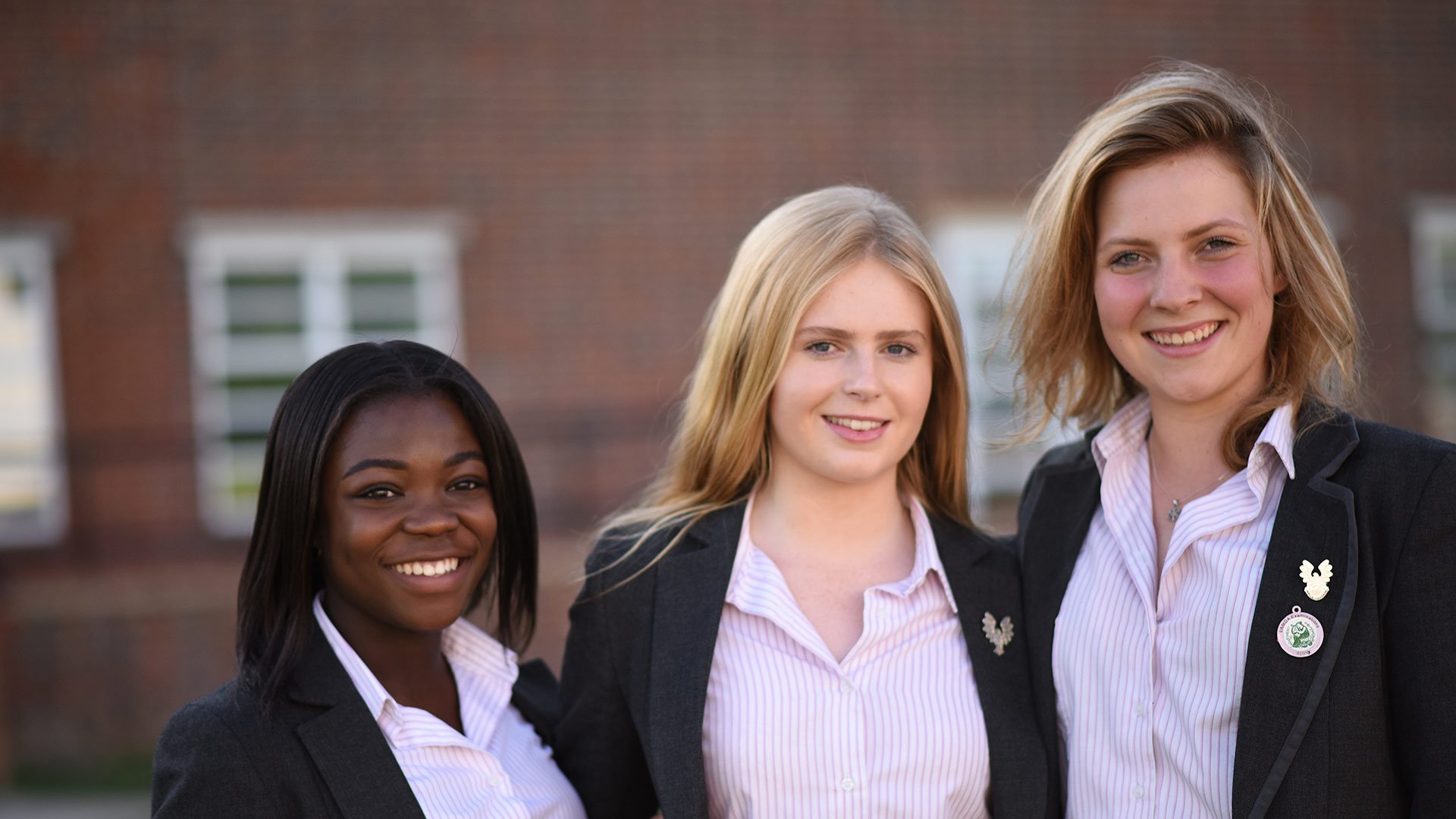
 We are committed to the benefits of single-sex education for girls, allowing our students to think, develop and learn in a supportive and challenging environment, free from gender stereotyping. This knowledge is built up over 140 years of experience of teaching girls.
Why All Girls?
Are all-girls’ schools still relevant in today’s world?
Yes. Research consistently supports what we observe: students in all-girls’ schools outperform their peers in co-educational settings. Girls in single-sex schools demonstrate higher levels of confidence and mental resilience. Evidence shows that, in co-ed environments, girls often avoid standing out and may lower their ambitions. In contrast, when surrounded by other high-achieving girls, they are more likely to set ambitious goals, engage in the classroom and have fun.
As educators in an all-girls setting, we understand the neurological differences in how boys and girls develop and learn. This insight allows us to create strategies, inside and outside the classroom, that are tailored exclusively to girls.
Studies by the Department for Education and the Girls’ Schools Association (GSA) reveal that girls in single-sex schools outperform their co-ed counterparts at GCSE and Sixth Form. They are twice as likely to study Physics or Further Maths and 70% more likely to take Chemistry and Computer Science.
Participation in sport is also higher: girls in single-sex schools are 25% more likely to play sports and five times more likely to play cricket. They are significantly less likely to drop out of sport during adolescence.
Despite progress, we still do not have a level playing field, and girls can, unfortunately, still at times be sidelined in co-educational environments. The world remains fractured, and we need strong, confident, creative, and independent women to lead with empathy. An all-girls’ education helps develop these qualities, equipping students to seize future opportunities.
Gender imbalance persists in the workplace, for example consider the tech sector, one of the fastest-growing industries. According to the World Economic Forum (2020), women make up only 22% of the global tech workforce. At BGS, our students grow in an environment free from unconscious gender bias, enabling them to aspire to any career they choose.
In an all-girls’ environment, everything is designed with girls in mind. Boys and girls develop emotionally and academically at different stages, so we focus entirely on the needs of our students. Academic approaches, sports, pastoral care, and co-curricular activities are all tailored for girls.
Our classrooms are free from gender stereotypes and girls are never considered second best. Girls like to have fun in different ways to boys - in an environment where girls can just be themselves we can create carefree moments that which appeal to them: from dance-offs, house competitions to talent shows, lunchtime karaoke, student led-pantomimes, well-being festivals and year group sleepovers our students can relax and be themselves. Girls’ schools offer joyful, collegiate environments for learning.
Examples of this in practice at BGS include:
- Lesson Approach Our lessons allow time for collaboration and discussion, an approach that suits girls best.
- Curriculums: Girls learn best through independent learning, creativity and taking self-agency. Our Junior School follows the IB Primary Years Programme which is an ideal curriculum to inspire girls’ to love learning and embed independent learning skills.
- Classroom atmosphere: Our classrooms are calm; girls respond better to positive reinforcement than raised voices.
- Teacher attention: Girls do not have to compete with boys for attention in class. Boys are often not aware but they tend to dominate spaces.
- Specialist resources: From specialist pastoral teams to sports teachers all are experts at supporting the development of girls and young women.
- Facilities: Our spaces are designed to support how girls’ study and socialise.
- Uniforms and kits: Designed specifically for girls, not adapted from male styles.
- Performing arts: Productions are chosen to provide challenging roles for girls.
- SEND support: We can focus strategies on identifying and supporting the needs of girls. Boys and girls often present differently and girls will often mask and may be overlooked in a co-ed environment. We are able to identify the small signs, the knowing behaviour patterns that might signal the need for further support.
Academics
Girls consistently achieve better outcomes in single-sex environments. Research from the GSA confirms this. Girls in all-girls schools are significantly more likely to pursue STEM subjects at university:
- Over four times as likely to apply for Maths
- Twice as likely to apply for Physical and Biological Sciences
- 40% more likely to apply for Engineering
Well over a third of our students go on to study a STEM related degree at world leading universities; whilst others pursue STEMM careers straight from school through apprenticeship schemes in areas such as the building sector and motor sports.
Girls in single-sex schools are far more likely to study STEM subjects and pursue careers in these fields. At BGS, almost 50% of our Sixth Form students study at least one STEM subject. For example on average 40% study Biology and 45% take Maths.
Absolutely, evidence shows that children start developing gender stereo-typing as young as the age of 7. Girls need to see themselves represented in role models. We introduce students to a wide range of female role models from the start of their education at BGS, showcasing diverse career paths. Our Alumnae Association is a network of “women supporting women”, providing mentorship and insight helping students pursue their aspirations.
Our alumnae succeed in male-dominated sectors such as the military, computer science, engineering, finance, and motorsport.
Statistics show that students from girl-only schools far exceed national levels for women in traditionally male careers.
- STEM careers: 50% of alumnae from GSA schools have worked in STEM (national average: 8%).
- Finance careers: 1 in 6 alumnae from GSA schools work in finance (national average: 3%).
Pastoral
Growing up is complex, and it is never a linear path. Friendships play a vital role in girls’ happiness and sense of self. Neurological differences mean that girls often experience friendship challenges more intensely. This occurs in all settings, but our expertise allows us to respond effectively. We use pastoral strategies tailored to girls and encourage wide friendship groups throughout the whole year cohort and extensive co-curricular programmes.
Research commissioned by the GSA shows that girls in single-sex schools develop stronger mental toughness and resilience compared to those in other settings.
In an all-girls setting we can allow students to make mistakes, learn and move on without a sense of shame. Girls can learn that taking risks is part of learning and they can do so without fear of judgement. This develops mental resilience and long term self-belief. We can be the safety net to nurture and support them but we can also challenge and encourage them to take academic risks in ways that work for girls.
This backed up by research, for example, a 2018 University of California, Los Angeles (UCLA) study of nearly 6,000 incoming female university students has found that graduates of all-girl schools are more likely to show higher levels of science self-confidence, consider themselves critical thinkers, score higher on measures of academic habits of mind, and demonstrate stronger study habits.
Confidence is key to building equitable relationships. A gender-stereotype-free environment fosters this confidence. It is really important that our students learn how to build respectful mutual friendships with boys. We also collaborate with other schools to provide opportunities for socialising and teamwork; in particular we partner with the boys at Bedford School. Our joint programme of activities includes:
- Termly Junior School joint learning days and seasonal led events
- Year 7 and 8 social activities and team building
- Joint PSHE programmes in Year 9
- Bi-annual main school musical and other on-going creative opportunities
- Choral and musical collaboration including events such as Open Mic Night and Battle of the Bands
- Debating Competitions and MUN conferences
- Combined Cadet Forces
- Sixth Form leadership programmes
- Sixth Form academic societies
- Joint Sixth Form sports and charity initiatives, and social events
In our single sex environment we can affirm and encourage young women in their capacities as individuals, leaders and agents of social change. Our students do not have to conform to sexist patterns of behaviour. They develop confidence in their own abilities as individuals, and do not define themselves by their gender. Girls hold all the senior positions, they are not tokens.
We know the importance of building resilience and intellectual risk taking, and we have an expert understanding of girls’ pastoral needs at every stage in their development. Because we are single sex, our students can be themselves and grow at their own pace. They can concentrate on their learning. They can learn from their mistakes without fear of being put down or dismissed. Without the presence of boys, they display their intelligence and curiosity regardless of powerful age-determined notions of popularity, attractiveness or negative peer pressure.
Learning at Bedford Girls' School
We have developed our model of education to integrate specific female-centred learning strategies to ensure we provide the challenge and nurture every student needs by:
- Using relevant real-world applications from girls’ lives
- Ensuring we're exploring the contribution of women of different backgrounds and ethnicities throughout our curriculum
- Using technology to encourage collaboration and creativity
- Allowing time for independent exploration
- Encouraging the girls to be bold and take risks in a safe non judgemental environment
- Ensure the explore their mistakes and see failure as a root to success
- Using writing as a means of learning any subject
- Always highlighting female role models and ensuring our incredible Alumnae are part of school life to demonstrate pathways to success across a huge range of fields
- Encouraging discussion; providing opportunities to find and use their authentic voices
- Personalising learning and limiting the use of academic setting
- Offering mentoring: peer to peer; alumnae to student and staff to student; giving our students the space to tackle their own challenges
- Ensuring all of our staff and parents understand how girls develop so we can fully support them through their neurological, psychological and physical changes
However, our students are not cloistered; we actively encourage them to engage in co-curricular co-educational activities beyond Bedford Girls’ School including opportunities for our students to collaborate with Bedford School. Our links with Bedford School are strong and continue to develop. We can provide the best of both worlds: single sex lessons, focussed exclusively on the needs of our girls; as well as a co-educational extra-curricular environment where the benefit from understanding the wider perspectives of others.
Our students soar in this environment.